

Hyacinth Ashley S. Flores | Geog 161 [Concepts and Principles of Land Use] THW Class
Posted on March 24, 2026
We often talk about landscapes as if they are static—the fields fixed in textbooks, the forests frozen in diagrams, the lakes represented only by their blue polygons in our maps. Too often engrossed in our own elaborate threads of living, we fail to remember that beyond the fixtures and bounds, landscapes breathe. They have a way of revealing themselves slowly. Sometimes they arrive through the crisp rustling of leaves, the shifting colors of the sky, the earthy musk of morning soil, or the melodious hum of distant roads. More often and quite eerily, they unveil their truths in subtler, more dangerous ways: in the tension between forests and farmlands, in the fragile balance between conservation and consumption, in the scars ingrained by development, and in the resilience of communities compelled to adapt to the weight of change. But even more dangerous is the way they surprise us in between heartbeats: over a towering storm surge, a wrathful typhoon, or in petrifying waves of flood. During our Academic Field Activity in Laguna, these truths unfolded right before us with clarity. Each stop was not merely a destination but a live chapter of a story written across mountains, campuses, farms, and lakeshores.

If learning in the classroom teaches us theories, walking through these spaces forces us to confront the complicated truths entangled within them: truths shaped by science, history, politics, and human responsibility. As we traversed from one place to another, it felt as though we were traversing the pages of a long, complicated narrative—one authored not by a single hand but by generations of Filipinos, by the ecosystems that govern the land’s behavior, and by the political decisions that determine the fate of its natural resources. Laguna is often admired for its serene landscapes. It hosts the gentle slopes of Mount Makiling that cradle the town, the lush canopies that filter the sunlight, the fertile fields that sustain livelihoods, and the vast Laguna de Bay shimmering like a great inland sea. But beneath this beauty lies a geography shaped by competing needs, contested claims, and histories of land use that are rarely simple.
Our field activity became an immersion into these layered realities. We witnessed how the principles we study—sustainability, spatial interaction, and ridge-to-reef connectivity—manifest beyond diagrams and lecture slides. They appear in the organic farms striving to heal the soil, in the forest trails that remind us of what remains protected, in the campus spaces shaped by memory and movement, and in the waters of Laguna de Bay that continue to bear the consequences of upstream decisions. These landscapes do not exist separately. They breathe, struggle, and transform as one interconnected system.
More than anything, the journey made it impossible to view geography as neutral. Every hillside cleared or conserved, every crop grown or abandoned, every campus tree spared or uprooted, every shoreline reinforced or neglected are decisions influenced by human intention, government priorities, and the socio-economic pressures of development. Geography is not a passive backdrop. It is a battleground of choices, a mirror reflecting what we prioritize and what we overlook.
Our walk through Laguna was therefore much more than an academic requirement. It was a reminder of the responsibility we carry as inhabitants of this land. To understand landscapes is to hear the conversations unfolding within them: between people and land, past and future, growth and preservation. And Laguna, in all its complexity, urged us to listen.
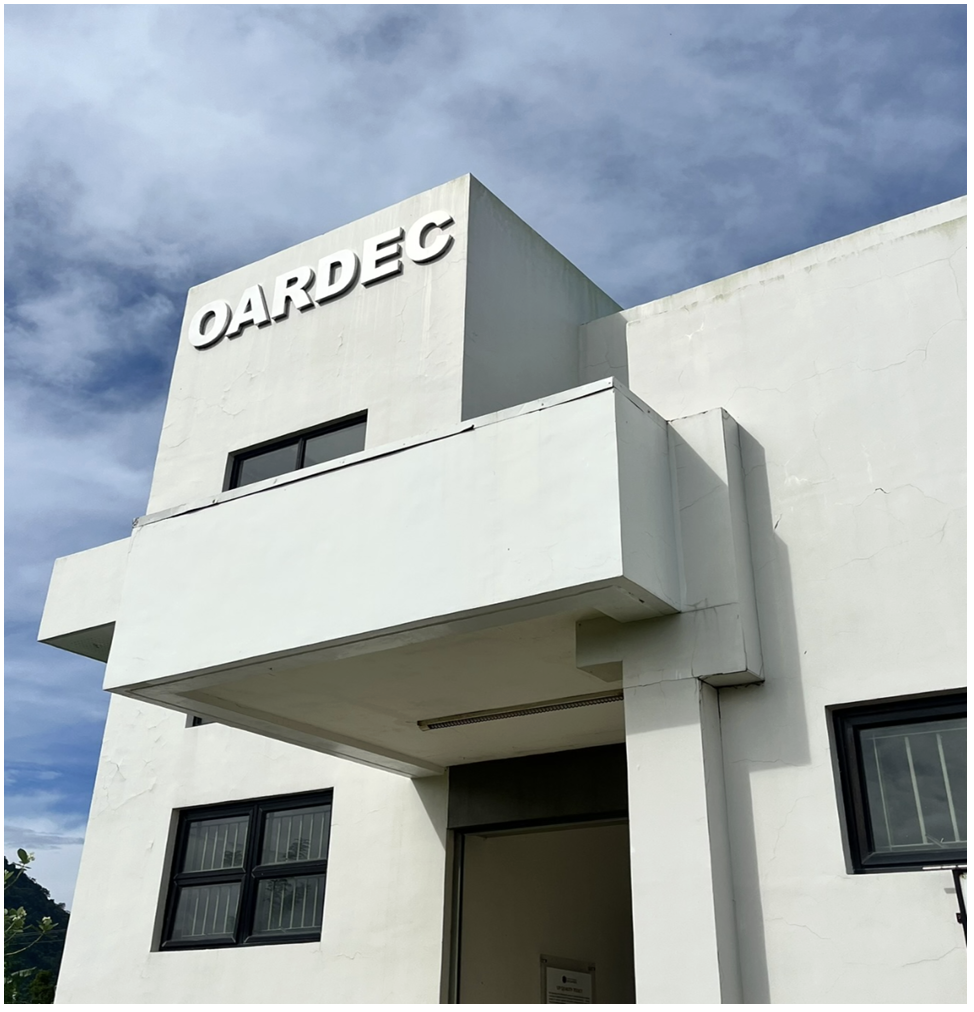
Organic Agriculture Research and Development Center (OARDEC)
Where Sustainable Futures are Grown by Hand
The Organic Agriculture Research and Development Center felt like entering a countercurrent in the country’s typical agricultural narrative. At first glance, the rows of vegetables, trees, and crops resemble any other experimental farm. It is a space where tarragon and akapulko can live in harmony with marigolds and pansit-pansitan, where garlic vines can crawl as freely as cobras can slither within its bounds (we saw one!) But looking more closely, it becomes clear that this space operates as a quiet resistance. It is an insistence that farming does not have to rely on chemical shortcuts that harm soils, waters, and farmers alike.
Here, soil is seen not as an input but as a living organism that needs nurturing. Compost pits are tended with intention. Plots are designed for diversity, not extraction. This is agriculture built on patience, science, and respect for ecological cycles. Yet the politics surrounding it become evident immediately: organic farming thrives here because it is supported by an institution, whereas farmers outside these academic borders often struggle with market barriers, policy gaps, and the cost of transitioning away from chemical-dependent systems. While the center tries its hardest to reach out to farmers and crop growers, the lack of governmental support makes OARDEC’s efforts an uphill battle. Amid the euphonic buzz of bees and serene hums of the wind is a sincere plea for help–for with the right support and backup, the center surely can do so much more.
OARDEC, in its quiet efficiency, reveals a powerful truth: sustainability is not simply a technique—it is a political choice. And in a country where land use too often favors short-term profit, this choice becomes revolutionary.


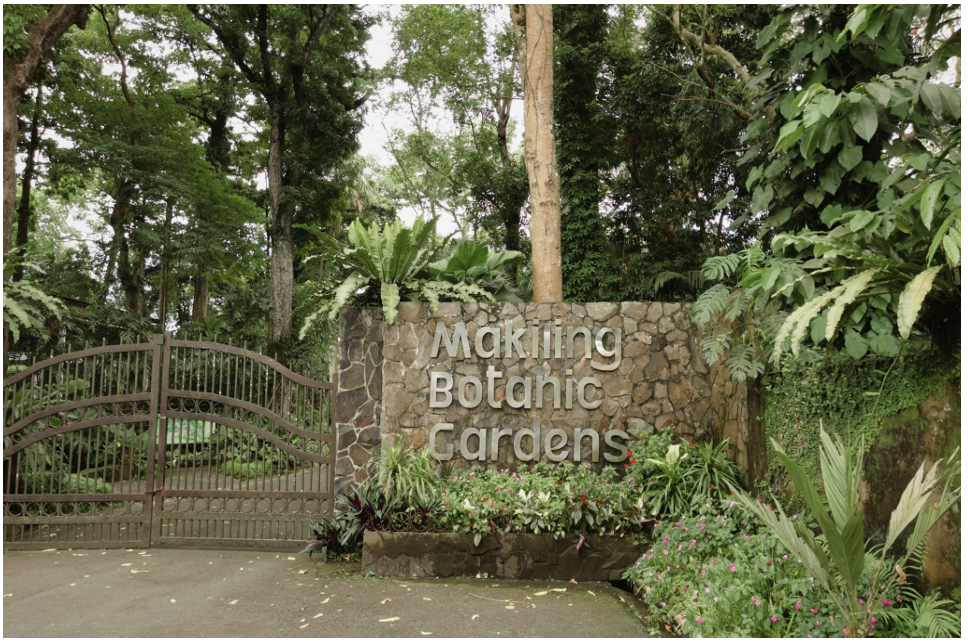
Makiling Botanic Garden
The Forest Whispers What Development Forgets
Traversing the Makiling Botanic Garden felt like entering a sanctuary untouched by the urban rush outside its gates. The forest canopy filtered the sunlight, the ground softened under fallen leaves, and the air was thick with the scent of damp earth. In this space, the ridges of Makiling reveal themselves not just as slopes of soil and stone but as guardians of the watershed—an ecological fortress that regulates climate, captures rainfall, and nurtures biodiversity.
The garden reminds us what a forest can provide when allowed to thrive: protection, resilience, and continuity. Yet even in its tranquility, the pressures at its borders are palpable. Urbanization creeps closer, tourists increase, and development proposals hover like distant storms. Makiling may feel protected, but it is not insulated from political decisions that can alter its boundaries or undermine its management.


The botanic garden stands as a living example of why upland protection matters—not only for biodiversity, but for downstream communities whose safety depends on the health of these forests. The ridge-to-reef concept materializes here in the rustling leaves, the flowing streams, and the sturdy tree trunks that silently shoulder the weight of entire watersheds.
UPLB Baker Hall
History Meets Unadulterated Neglect
Baker Hall stands as one of UPLB’s most haunting structures. It’s a building whose walls remember far more than they reveal. Once a gymnasium, later a Japanese internment camp during the Second World War, and now a cultural and historical landmark, it embodies a lineage marked by conflict, survival, and reinvention. Standing in front of its aging exterior, it becomes impossible not to feel the weight of the stories held within its wooden beams and weathered concrete—a reminder that landscapes are not simply shaped by natural forces, but by the traumas and choices of human history.
Yet what surrounded Baker Hall struck us just as strongly as the hall itself. Directly in front of this historic structure lies the unfinished, long-abandoned stadium: a skeletal reminder of halted ambition. Its bare, incomplete form stands in stark contrast to Baker Hall’s enduring presence. Here, memory and stagnation coexist: one structure containing decades of lived history and the other symbolizing the bureaucratic gridlocks and political inertia that pervade infrastructure development in the country.
The stadium’s immobility raises uncomfortable questions. How many projects like this remain suspended in time—funded, publicized, begun, then mysteriously halted? How many communities have waited for facilities promised to them but never delivered? Where Baker Hall stands as a testament to resilience, the unfinished stadium stands as a monument to neglect. The juxtaposition reveals the uneven priorities that shape public spaces, where heritage structures endure despite minimal resources, while modern projects collapse under the weight of administrative shortcomings.
Standing between these two structures—one historical and one abandoned—was like standing between two eras of governance: the past, which survived despite violence and upheaval, and the present, which often struggles to complete what it starts. Landscape then becomes a visual critique, questioning not only how we preserve our history, but also how we build our future, and for whom these spaces are truly intended.
Laguna de Bay Drive Through
Juxtaposition of Livelihood, Loss, and Gain
Laguna de Bay—the country’s largest inland water body—was the final and most sobering stop. Its murky brown waves belied the complex ecological and political tensions embedded within its waters. At the shore, the contrast was stark: a breathtaking horizon blurred with the realities of fishpens, pollution, shoreline encroachment, and communities living at the mercy of floods. Here, the ridge-to-reef continuum becomes painfully visible. Soil erosion from upland areas, wastewater from towns and industrial zones, poorly regulated development, and climate variability all flow downstream into the lake. For decades, Laguna de Bay has absorbed the consequences of fragmented governance and misaligned priorities. The lake is both a resource and a contested territory: central to livelihoods, transportation, aquaculture, and urban expansion. From the garbage that lines its coast to the water that touches the stilts of the surrounding houses, it became clear that the lake is more than a body of water. It is a mirror reflecting the decisions of the entire watershed. Its challenges are not simply ecological—they are political, economic, and profoundly human.
Overall, the Academic Field Activity in Laguna was more than a geographic tour—it was a confrontation with the interconnectedness of ecological systems and the political decisions that shape them. From sustainable farming initiatives to protected forests, from historically charged campus spaces to the vulnerable shores of Laguna de Bay, each landscape emphasized a crucial truth: environments are not passive backdrops. They are shaped, contested, and continually transformed by human decisions.

To walk through Laguna is to witness geography in action—alive, complex, and deeply political. As students of the environment, the responsibility falls on us not only to understand these places but also to advocate for decisions that honor their interconnectedness. And if there is anything this journey made clear, it is that the landscapes we inherit will always reflect the choices we make.


Hyacinth Ashley Flores is a BS Geodetic Engineering student with a passion for traversing boundaries and weaving life into prose.
This AFA Spotlight article is part of a collection of articles about this Off-Campus AFA in Laguna. View the other articles in this collection here.